Buying a Home with a Radon System? Here’s Why Testing Still Matters
One of the most common assumptions I hear during home inspections goes something like this:
“The house already has a radon mitigation system, so we don’t need to test, right?”
On the surface, that sounds reasonable. After all, if a mitigation system is installed and the manometer shows it’s pulling negative pressure, it must be doing its job.
But here’s the reality, and it’s something every homebuyer in Kingsport, Johnson City, and Bristol should understand:
A home with a radon mitigation system is not a reason to skip testing. It’s actually a reason to test.
A Real-World Example from the Field
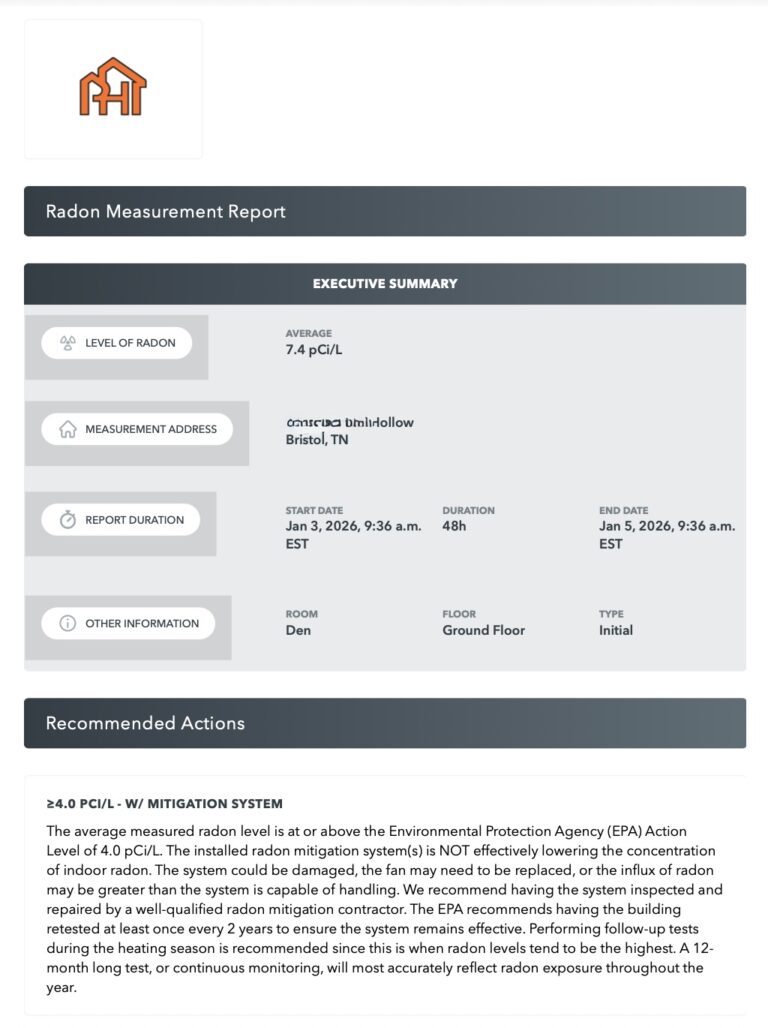
Recently, I tested a home that already had a radon mitigation system installed. The system appeared to be functioning properly. The fan was running, and the manometer showed negative pressure, exactly what you want to see.
Yet after a standard 48-hour radon test, the average indoor radon level came back at 7.4 pCi/L.
That’s nearly double the Environmental Protection Agency’s recommended action level of 4.0 pCi/L.
Nothing about the system looked wrong. But the data told a very different story.
This is where relying on assumptions instead of testing can become a serious mistake for buyers.
What the EPA Says About Radon Levels
According to the U.S. Environmental Protection Agency (EPA):
Radon is a colorless, odorless radioactive gas
Long-term exposure is the second leading cause of lung cancer, behind smoking
The EPA recommends taking action when radon levels are 4.0 pCi/L or higher
👉 EPA Action Level reference:
https://www.epa.gov/radon/what-epa-is-doing-about-radon
Radon isn’t rare, and it isn’t limited to old homes or homes without mitigation. In fact, elevated radon levels are common throughout East Tennessee, including the Tri-Cities region.
Why Mitigation Systems Still Need to Be Tested
Here’s the key point that often gets missed:
A radon mitigation system reduces radon levels, it does not guarantee safe levels.
The EPA specifically states that radon mitigation systems can:
Underperform
Lose effectiveness over time
Be improperly designed for the structure
Be overwhelmed by higher-than-anticipated radon concentrations
Fail mechanically (fans do wear out)
👉 EPA guidance on mitigation system performance:
https://www.epa.gov/radon/radon-mitigation-standards
In other words, a mitigation system is not a “set it and forget it” solution.
It’s a system that must be verified through testing.
The Knee-Jerk Assumption That Hurts Buyers
The most dangerous assumption I see is this:
“If there’s a mitigation system, the problem must already be solved.”
But the presence of a mitigation system actually tells us something important:
This home has a known radon history.
That alone should trigger follow-up testing, especially during a real estate transaction when you still have options.
Skipping radon testing because a system exists removes one of the buyer’s most important decision-making tools: data.
Seasonal Radon Fluctuations Matter
Radon levels are not static. The EPA makes this very clear.
Radon concentrations tend to be:
Higher during colder months
Affected by indoor air pressure changes
Influenced by soil moisture and ground conditions
👉 EPA explanation of seasonal radon variation:
https://www.epa.gov/radon/radon-testing
This is why a mitigation system that “worked” years ago, or even last summer, may not be performing adequately today.
It’s also why testing during the heating season often reveals the highest and most accurate exposure levels.
What This Means for Homebuyers
If you’re buying a home in Kingsport, Johnson City, Bristol, or anywhere in Northeast Tennessee, here’s the takeaway:
A radon mitigation system is not proof of safety
A visible manometer reading is not a radon test
The only way to know current radon levels is to test
Testing protects your health and your leverage during negotiations
Radon testing is inexpensive compared to the potential health risks, and compared to the cost of repairing or upgrading an underperforming system after closing.
Why I Always Recommend Testing (Even with Mitigation)
My job as an inspector is not to assume. It’s to verify.
I don’t work off “probably fine” or “it looks like it’s working.”
I work off measured data, because that’s what allows buyers to make informed decisions.
A radon mitigation system should lower levels into a safer range. Testing confirms whether that’s actually happening.
Final Thought
If there’s one thing I want buyers to remember, it’s this:
The presence of a radon mitigation system doesn’t eliminate the need for radon testing, it increases the importance of it.
Testing isn’t about fear. It’s about clarity.
And clarity is what allows you to move forward with confidence, or pause when you need to.